

Showing posts with label LPR Cameras. Show all posts
Showing posts with label LPR Cameras. Show all posts
License Plate Reading Camera Locations in the U.S.

License Plate Reader Cameras
A lot of drivers get confused about the different types of cameras being used. Drivers often confuse traffic cameras (located on the top of traffic lights) with red light cameras (located on the side of the road). These cameras are license plate readers and are using track vehicles and are not used to enforced speeding or red-light running. The use of license plate reading cameras is rapidly on the rise. If you would like to read more about them see this Arstechnica article.
We recently started a new category (license plate camera) in our database to track license plate reading cameras simply to minimize the confusion about the different types of cameras with our readers. We get hundreds of erroneous red light cameras locations submitted to our database every month. When in fact these locations are license plate but most likely traffic flow monitoring cameras. Having a new category of cameras we track in the database should help minimize driver confusion. Read also our articles on traffic flow cameras.
Across the U.S., drivers are increasingly noticing cameras at intersections, along highways, and in parking facilities. Many assume these devices are speed or red-light enforcement tools, but in many cases they are license plate reading cameras (LPRs). These specialized systems are designed to scan and record license plates, not necessarily to issue tickets. Understanding where LPR cameras are located and how they function can help drivers separate fact from fear.
Common Locations of License Plate Readers

License plate readers are strategically placed to maximize coverage, efficiency, and usefulness for law enforcement, transportation agencies, and private operators. The most common locations include:
-
Highway Overpasses and Ramps
-
Positioned on overhead gantries or bridges.
-
Used for toll collection, stolen vehicle detection, and traffic analysis.
-
-
Busy Intersections
-
Mounted on poles near traffic lights or traffic signs.
-
Often confused with red-light cameras, but usually used for tracking flow, Amber Alerts, and crime prevention.
-
-
Parking Lots and Garages
-
Found at airports, shopping malls, universities, and private garages.
-
Used to monitor overstays, enforce permits, and simplify automated entry/exit.
-
-
Police Vehicles
-
Mobile LPRs mounted on the roof or trunk of patrol cars.
-
Allow officers to scan plates while driving, instantly flagging wanted or stolen vehicles.
-
-
Residential & Gated Communities
-
Installed at entry gates to monitor traffic in and out of private neighborhoods.
-
Helps property managers enforce access rules and track visitors.
-
-
Border Crossings
-
Widely used at international checkpoints.
-
Helps customs and immigration agencies track vehicles entering or leaving the country.
-
Why These Locations Matter
The placement of license plate reading cameras isn’t random. Each location serves a strategic purpose:
-
Highways & Ramps: Maximizes the number of vehicles scanned, improving tolling and stolen vehicle recovery.
-
Intersections: Provides valuable data for traffic safety and criminal investigations.
-
Parking Facilities: Reduces labor costs while improving enforcement.
-
Police Cruisers: Extends coverage beyond fixed locations.
-
Borders: Enhances national security and monitors cross-border crime.
LPRs vs. Other Cameras
Driver confusion stems from the variety of cameras on roadsides:
-
Traffic Flow Cameras: Positioned high above roads, designed to measure congestion.
-
Red-Light Cameras: Located at intersections, angled to capture vehicles that run red lights.
-
Speed Cameras: Often box-like, placed on poles or trailers to detect speed violations.
-
License Plate Readers: Mounted lower or angled specifically to capture plates, not issue tickets for moving violations.
By knowing which camera is which, drivers can better understand whether a device is monitoring behavior or simply recording movement.
National Expansion of LPR Networks
The presence of license plate readers is rapidly expanding nationwide. Urban centers deploy them for law enforcement, suburban counties add them for traffic monitoring, and private entities invest in them for parking enforcement. The rise of cashless tolling and congestion pricing zones has only accelerated their spread.
For example:
-
New York City uses LPRs in its congestion pricing program.
-
Los Angeles and Chicago integrate them into both traffic flow and law enforcement operations.
-
Smaller communities are increasingly adopting fixed LPR units to supplement limited police manpower.
Privacy Concerns Around Location Tracking
Because LPRs are strategically positioned in high-traffic areas, concerns arise about constant surveillance. Drivers often ask:
-
How long is data stored? Some agencies delete after 30 days, others keep records for years.
-
Who can access the data? Local police, state agencies, and sometimes federal authorities share data across networks.
-
Can private companies misuse it? Parking firms and repossession agencies often run their own LPR systems.
Public debate continues about whether these widespread locations create a “tracking grid” of vehicle movement.
Why We Track LPR Locations in Our Database
At PhotoEnforced.com, we receive thousands of camera location submissions from drivers every year. Many of these are mistakenly flagged as red-light cameras, when in fact they are license plate readers or traffic monitoring cameras.
To reduce confusion, we added a dedicated license plate camera category in our database. This helps drivers distinguish between:
-
Locations where tickets are issued.
-
Locations where plates are scanned for data, security, or tolling.
Knowing the difference not only eases anxiety but also helps educate the public about how roadway surveillance is evolving.
International Examples of LPR Locations
LPR locations aren’t limited to the U.S.:
-
London uses them throughout its congestion charge zone.
-
Singapore has citywide LPR coverage integrated with traffic management.
-
Australia deploys mobile and fixed LPRs for both police and tolling.
Globally, LPR placement is guided by the same principle: maximum coverage at choke points like tolls, borders, and intersections.
The Future of LPR Camera Locations
As technology evolves, the number and variety of LPR locations will continue to grow. Emerging trends include:
-
Integration with Smart Traffic Lights: Automatically adjusting signals based on real-time flow data.
-
Neighborhood Security Networks: Communities pooling resources to install LPRs at every entry/exit.
-
Expanded Highway Networks: Cashless tolling spreading across more U.S. states.
-
Private Sector Growth: Retailers, universities, and even hospitals deploying LPRs for security and parking management.
Conclusion
License plate reading cameras are no longer rare—they are a permanent feature of modern roads and communities. Found on highways, intersections, police cruisers, parking lots, borders, and residential neighborhoods, these cameras serve many purposes beyond issuing tickets. While they improve efficiency, safety, and enforcement, they also raise important debates about privacy and data security.
By clearly identifying and categorizing these cameras, databases like PhotoEnforced.com help drivers understand the difference between enforcement tools and monitoring systems. Knowing where license plate cameras are located allows drivers to make sense of the growing network of roadside technology that shapes today’s driving experience.
Obstructing Your License Plate Is Illegal: What You Need to Kno

When it comes to driving legally on public roads, there are many rules that motorists must follow—but one often overlooked regulation is the requirement for a clear and unobstructed license plate. Whether you’re driving a car, truck, or motorcycle, obstructing your license plate is illegal in most states, and it can result in fines, penalties, or even more serious consequences.
In this article, we’ll break down why license plate obstruction is a big deal, the common ways people accidentally (or intentionally) block their plates, and how to stay compliant with the law.
Why Is Obstructing a License Plate Illegal?
Your license plate serves a critical function: it identifies your vehicle. Law enforcement uses it to track stolen cars, issue traffic citations, and manage road safety. That’s why every state requires plates to be:
-
Clearly visible
-
Easily readable
-
Free from obstruction or cover
Obstructing your plate can be seen as an attempt to evade detection, tolls, or red-light cameras. As such, even minor infractions are taken seriously by law enforcement.
Common Ways People Obstruct License Plates
You might be breaking the law without even realizing it. Here are some common plate obstructions that can get you into trouble:
1. Plate Covers and Frames
Tinted, smoked, or even clear plastic covers can distort the plate under certain lighting. Some decorative frames also cover key portions of the plate number or state name.
2. License Plate Flippers and Reflective Coatings
Some drivers try to avoid tolls or speed cameras using devices that flip the plate or reflect light to make it unreadable. These are illegal in all 50 states and can lead to hefty fines.
3. Dirt, Snow, or Debris
Even unintentionally covering your plate with mud, snow, or bumper stickers is considered an obstruction in many jurisdictions. It’s your responsibility to keep the plate clean and visible at all times.
4. Obstructed by Bike Racks or Tow Equipment
Make sure bike racks, trailers, or tow hitches don’t block the view of your license plate. If they do, you may be required to relocate the plate or use a supplemental mount.
Penalties for Obstructing Your License Plate
Penalties vary by state but can include:
-
Fines ranging from $50 to $500
-
Points on your driving record
-
Vehicle inspection failures
-
Possible court appearances for repeat offenses
In some cases, intentional obstruction can be charged as a misdemeanor, especially if it’s linked to avoiding tolls or committing other violations.
How to Stay Legal
Here’s how to ensure your plate is always in compliance:
-
Avoid any aftermarket plate covers or tints
-
Use only legal, non-obstructive plate frames
-
Regularly clean your plate of dirt or snow
-
Make sure no objects or accessories block the view
-
Replace any damaged or faded plates through your DMV
Final Thoughts
It might seem like a small thing, but obstructing your license plate—even partially—is against the law and can lead to real consequences. It’s a simple fix that could save you money, hassle, and legal trouble down the road.
Stay visible, stay legal, and drive smart.
License Plate Covers & Sprays Don’t Work — Here’s Why
License Plate Covers and Sprays Don’t Work — Here’s Why
For more than a decade, companies have marketed license plate sprays and covers that promise to make your car invisible to traffic cameras. The ads claim these “stealth” solutions can outsmart red-light cameras, speed cameras, and automated license plate readers (ALPRs) used by police and toll agencies. They promise an easy fix: a few sprays or a clear plastic cover, and you can drive freely without worrying about tickets or tolls. Unfortunately, real-world testing and scientific evidence show the truth — license plate covers and sprays don’t work.
From early tests in Iowa to modern investigations by British lawmakers and American transportation agencies, these gimmicks have repeatedly failed. Worse, using them may put you on the wrong side of the law, exposing you to fines or even criminal penalties. This article breaks down the history, technology, and legal reality behind the myth — and why smarter enforcement systems make “ghost plates” impossible to rely on.
The 2010 Cedar Rapids Experiment
Back in 2010, a local news team in Cedar Rapids, Iowa, teamed up with police to test one of the most popular products at the time: PhotoBlocker spray. The product claimed to “make your license plate invisible to cameras” by reflecting light back at the camera flash.
To test it, officers removed a vehicle’s plate, applied five coats of the spray, reinstalled it, and drove through intersections equipped with red-light and speed cameras. The result? Every photo captured by the city’s camera system showed a perfectly clear plate. The spray made no difference at all.
Police concluded the test with a warning: “If it’s too good to be true, it probably is.” In other words, the only real way to avoid a ticket was simple — obey the law.
Why the Science Doesn’t Work
The premise of license plate spray is that it can reflect or distort the light used by traffic cameras. These systems often use infrared illumination (IR) or bright flash photography to capture plates under all lighting conditions. The spray is supposed to create a reflective layer that overexposes the image, blurring the characters.
However, modern cameras use advanced optics and software that automatically adjust exposure and contrast. They’re also designed to capture multiple images at slightly different angles and wavelengths. That means even if one photo is washed out, another will be readable.
In short: a $30 spray can’t defeat a $50,000 camera system. The same applies to clear plastic license plate covers marketed as “photo blockers.” While they might reflect sunlight or glare from a phone camera, they fail against the specialized sensors used by traffic enforcement systems.
The Rise of “Ghost Plates” in the U.K.
In 2025, the British government launched a Parliamentary inquiry into the growing use of ghost plates — illegal or modified number plates that fool ANPR (Automatic Number Plate Recognition) cameras. Drivers were using reflective films, altered fonts, and even fake cloned plates to evade detection.
Lawmakers discovered more than 130 licensed suppliers selling illegal or unreadable plates, and a black market thriving on TikTok and eBay. Offenders weren’t just dodging speeding tickets; organized criminal groups were using ghost plates to move stolen vehicles and avoid detection during crimes.
The findings echoed what American cities learned years earlier: no matter how clever the product claims to be, camera enforcement always evolves faster.
Why License Plate Sprays and Covers Fail in 2025
1. Infrared and Polarized Detection: Modern cameras use IR illumination invisible to the human eye. Reflective sprays don’t distort IR wavelengths effectively, so the characters remain visible. Cameras also use polarization filters that cut glare and compensate for reflective surfaces.
2. Multi-Angle Capture: Many U.S. systems like Redflex and Verra Mobility now use dual-angle cameras to take simultaneous shots of the plate from two perspectives. Even if one angle produces glare, the other is clear.
3. AI Image Correction: Enforcement systems now use machine learning to reconstruct plate numbers even from partial or blurred images. Algorithms fill in missing pixels or compare to vehicle databases.
4. Manual Review: When automated systems fail to read a plate, trained reviewers examine the image manually. If the plate is found intentionally obscured, drivers may receive an “obstructed plate” citation — often a higher fine than a regular speeding ticket.
5. Stronger Materials Standards: States like California and New York now require plates made from retroreflective materials designed to resist tampering and allow accurate capture even under heavy reflection.
Together, these advances mean that even if a spray causes temporary glare, enforcement systems can still extract your plate data with little effort.
U.S. Enforcement: Stronger Laws and Bigger Fines
Across the U.S., altering, obscuring, or covering a license plate is illegal in nearly every state. Here are a few examples:
-
California: Vehicle Code §5201 prohibits any cover or coating that obstructs visibility or alters plate reflectivity. Fines can exceed $250 per violation.
-
New York: Police have issued thousands of tickets in “Operation Clear Plate,” targeting cars with tinted covers or ghost plates.
-
Florida: Possession of plate-flipping devices or sprays used to obstruct cameras can carry fines up to $5,000 and possible impoundment.
-
Texas: State lawmakers have debated micro-etching and RFID chips to authenticate plates and catch counterfeits.
In every case, authorities emphasize that even attempting to alter your plate’s visibility can bring penalties greater than the traffic fine you were trying to avoid.
False Security and Real Consequences
Many drivers buy sprays and covers believing they’re harmless — after all, the plate still “looks fine” to the naked eye. But police and insurers treat it differently.
If you’re caught using a device or spray that interferes with enforcement, you can be cited for obstructing a license plate or tampering with vehicle identification. In some states, it’s classified as a misdemeanor.
And if that same plate is used in a crash, hit-and-run, or stolen-vehicle investigation, you may face criminal exposure far beyond a speeding ticket. Insurers can deny claims if your vehicle is found to have illegal modifications.
Even worse, when these products fail — as most do — drivers still receive citations and often end up paying two fines instead of one.
What Independent Tests Show
Independent tests across both the U.S. and Europe have consistently disproven the claims of spray and cover manufacturers:
-
RadarTest.com concluded after multiple trials: “Photoblocker spray had zero effect on cameras.”
-
ProductReview.com.au users reported that the spray “made the plate more visible.”
-
UK police trials of reflective films found 100% legibility of plates under infrared camera light.
-
Consumer Reports warned in its road-safety bulletin that such products offer “a false sense of immunity from detection” and can lead to more aggressive driving behavior.
These findings line up with what police observed in Cedar Rapids 15 years ago — despite new marketing and packaging, the core problem hasn’t changed.
Safer and Legal Alternatives
If your motivation is privacy rather than evasion, there are legal ways to protect your information without breaking the law:
-
Request ALPR data deletion: Some U.S. cities let residents request removal of non-criminal license plate data from databases.
-
Install a dash cam: Protect yourself from false accusations with your own record of traffic events.
-
Avoid aftermarket plate frames or tints: Keep your plate clean, visible, and compliant with state standards.
-
Drive responsibly: The simplest, cheapest way to avoid tickets is to obey posted limits and stop lights.
For privacy-minded drivers, advocacy for better data-retention limits and transparency laws is more effective than resorting to products that don’t work.
The Bigger Picture: Technology Always Wins
Traffic enforcement technology has become smarter, faster, and more integrated. Systems now link cameras, toll databases, and DMV records in real time. The idea that a spray or cover could outsmart that ecosystem is outdated.
In the U.K., police are testing AI-driven camera systems that detect altered plates automatically. In the U.S., highway patrol units use mobile ALPR scanners capable of reading hundreds of plates per minute from moving vehicles — day or night.
Against that backdrop, the logic of a reflective spray simply doesn’t hold up.
Final Thoughts
Fifteen years after the first “PhotoBlocker” test in Iowa, the verdict is still the same: license plate sprays and covers don’t work. They fail under modern technology, invite legal trouble, and ultimately offer false confidence that can lead to riskier driving.
If your goal is to avoid fines, the answer isn’t chemical coatings or tinted plastic — it’s safe, lawful driving. If your goal is privacy, push for smarter laws on data retention, not illegal products that can backfire.
The bottom line hasn’t changed since 2010: The only guaranteed way to avoid camera tickets is to drive responsibly and keep your plate clean and legal.
Facts a Police Officer Must Verify Before Issuing a Ticket
When a police officer pulls over a vehicle, it's not as simple as writing a ticket right away. There are specific facts and legal steps officers must verify before issuing a citation. Understanding these requirements can help drivers protect their rights and avoid unjust penalties.
In this article, we’ll break down the key facts a police officer must confirm before issuing a ticket, whether it’s for speeding, running a red light, illegal parking, or another traffic violation.
1. Probable Cause for the Stop
Before any ticket can be written, a police officer must have probable cause to initiate a traffic stop. This means the officer must observe a clear violation of traffic law or have a reasonable suspicion of criminal activity.
Examples of Probable Cause:
-
Speeding over the posted limit (measured with radar or LIDAR)
-
Failing to stop at a stop sign or red light
-
Weaving between lanes (possible DUI)
-
Expired registration or visible vehicle defects (e.g., broken tail light)
2. Driver Identification
Once the vehicle is stopped, the officer must verify the identity of the driver. This includes checking:
-
Valid driver’s license
-
Vehicle registration
-
Proof of insurance
If any of these documents are missing, expired, or fraudulent, the officer may issue additional citations beyond the initial reason for the stop.
3. Accurate Speed Measurement (for Speeding Tickets)
For speeding tickets, officers must have clear and accurate evidence of the driver’s speed. This is typically done using:
-
Radar guns
-
LIDAR systems
-
Pacing (using the officer’s own speedometer while following the car)
-
Speed cameras (in jurisdictions where they are legal)
Officers are also required to be trained and certified to use speed detection equipment. Malfunctioning or uncalibrated devices can lead to a ticket being dismissed in court.
4. Clear Signage and Road Markings
Officers must ensure that traffic laws were violated in a clearly marked zone. For example:
-
Speed limits must be posted at regular intervals
-
No-parking zones must be clearly signed
-
Stop signs and traffic signals must be visible and unobstructed
If signage is missing, obscured, or incorrect, a driver may be able to contest the ticket successfully.
5. Legal Authority and Jurisdiction
A police officer must have the jurisdiction and authority to enforce traffic laws in the location where the violation occurred. For example, a campus security officer cannot issue state traffic tickets unless granted specific authority.
6. Documented Evidence
In many cases, especially when drivers contest tickets, courts require that officers provide:
-
Written notes or dashcam/bodycam footage
-
Accurate time and location of the offense
-
Description of the vehicle and driver’s behavior
This documentation helps ensure tickets are based on facts, not assumptions.
7. Driver’s Right to Explanation
Though not a requirement for issuing a ticket, police are expected to allow the driver a chance to explain. This can sometimes lead to a warning instead of a citation, especially for minor infractions.
Final Thoughts
Traffic tickets are legal documents, and police officers must verify multiple facts before they can be lawfully issued. If any of these elements are missing, the ticket may be invalid or subject to dismissal in court.
Understanding your rights and the legal obligations of law enforcement can help you make informed decisions during traffic stops. If you believe a ticket was issued without proper verification, consider consulting a traffic attorney or contesting it in court.
How Do Red Light Cameras Work

Red-light cameras remain one of the most debated traffic enforcement tools in the United States. Supporters argue they save lives by discouraging dangerous intersection behavior, while critics insist they are revenue-driven and sometimes unfair. Since our original article in 2010, camera technology has advanced, laws have shifted, and studies have provided clearer insight into their effectiveness. This 2025 update explores how red-light cameras work today, where they are legal, their impact on safety, and what changes may be coming.
How Red-Light Cameras Work
At their core, red-light cameras are designed to automatically enforce traffic laws when a driver runs a red light. The process involves several technical steps:
1. Sensors and Signal Synchronization – Inductive loops, radar, or video-based detectors are embedded near the stop line of an intersection. These sensors are connected to the traffic light controller, so the system knows precisely when the signal changes.
2. Violation Detection – When a vehicle crosses into the intersection after the light has turned red—usually after a brief “grace period”—the system triggers. Many programs also require the vehicle to be traveling at a minimum speed to avoid false triggers.
3. Image and Video Capture – Multiple photos and a short video clip are recorded. Typically, one image shows the vehicle at the stop line with the light red, and another shows the vehicle fully inside the intersection. These captures are timestamped and include metadata such as location, signal status, and sometimes speed.
4. Human Review – Evidence is reviewed by trained law enforcement or authorized staff to confirm the violation. This step reduces false positives and ensures that emergency vehicles or unusual circumstances are excluded.
5. Citation Issuance – Once verified, a citation is mailed to the registered vehicle owner, often including a link to the evidence video.
Advances in Camera Technology
Modern red-light camera systems are far more advanced than their early counterparts: higher resolution imaging captures license plates clearly at night or in bad weather, AI-powered detection reduces false triggers, combination units enforce multiple violations such as speeding or school bus stop-arms, and public dashboards increase transparency by reporting crashes, citations, and revenue.
Where Are Red-Light Cameras Legal in 2025?
The legality of red-light cameras remains fragmented across the U.S. They are permitted in 25 states plus Washington, D.C., with programs expanding in states like New York, Illinois, and Florida. Texas and several others ban them statewide, citing fairness and revenue concerns. In California, Senate Bill 720, known as the Safer Streets Program, is reshaping enforcement by requiring more oversight, addressing privacy issues, and giving local jurisdictions flexibility. Some jurisdictions, such as Sacramento County, discontinued their programs in 2024 due to operating costs exceeding ticket revenue.
Do Red-Light Cameras Improve Safety?
Evidence of Benefits – Studies show fatal red-light running crashes drop by about 21% in cities with camera enforcement. Right-angle “T-bone” crashes decline nearly 30%. Programs that are shut down often see crashes rise again.
Limitations and Criticism – Some jurisdictions report increases in rear-end collisions as drivers brake suddenly, though these are usually less severe than side impacts. Critics argue revenue motives undermine public trust, and courts have raised due process questions when citations are issued without enough human oversight.
How Citations Are Processed
States treat citations differently. Some classify them as civil infractions without DMV points, while others assign them as moving violations. Fines range from $50 to $500, with California among the highest. Appeals are possible, often focusing on faulty equipment, unclear signage, or necessity defenses, such as avoiding a collision.
In some states, red light camera tickets only need to photograph the car from behind, since the authorities only need a clear view of the rear license plate. In other states, the actual driver is responsible for paying the ticket and must be verified. If you were not the driver of the car often times you will be threatened to turning in the driver which is referred to as a snitch ticket. In this case, the photo enforced system needs a second camera in front of the car, in order to get a shot of the driver's face. The ticket is still sent to the car's owner after verification.
Public Opinion and Ongoing Debate
Public opinion remains divided. Support is strongest in cities that provide transparency, post clear warning signs, and demonstrate crash reductions. Opposition grows when cameras are viewed as “hidden” or primarily revenue-driven. With modern AI and oversight measures, some jurisdictions are regaining trust in automated enforcement.
The Future of Red-Light Enforcement
Red-light enforcement is evolving toward integration with smart city traffic management systems, equity considerations to prevent disproportionate impacts on low-income drivers, alternative penalties such as education courses, and reliance on in-vehicle technology like Automatic Emergency Braking (AEB). Over the next decade, a combination of enforcement and driver-assist technology may reduce the need for widespread camera deployment.
Conclusion
Red-light cameras have changed significantly since their introduction. They remain controversial but have proven effective in reducing dangerous crashes and saving lives. As laws evolve, technology advances, and oversight improves, the balance between safety, fairness, and revenue will continue to shape how red-light cameras are used in 2025 and beyond.
More Details on How Cameras Are Triggered.
A typical red light camera intersection has cameras positioned at a corner of an intersection, on poles a few yards high. The video and photo cameras point towards oncoming traffic so the cameras can photograph or video cars driving through the intersection. Red-light systems do not necessarily have cameras at all four corners of an intersection. Some intersections also have cameras to capture traffic photos from the rear.


Does License Plate Blocker Spray Work?

Automated license-plate readers (ALPR/ANPR) and traffic enforcement cameras are increasingly used across the UK and the U.S. to capture offenses such as speeding, red light running, toll evasion, and congestion-zone violations. Many drivers, however, are turning to so-called license plate blocker sprays, films, or covers in hopes of defeating these systems. But do these products actually work — and what are the legal risks? Here’s a comprehensive look.
What are license plate blocker sprays and covers?
These products are marketed as ways to make your vehicle’s registration number unreadable to enforcement cameras, while remaining visible to the naked eye. Common claims include:
-
A spray that creates a highly reflective surface so that the camera flash over-exposes the plate image.
-
A transparent film or cover that distorts or obscures the plate when viewed at an angle but looks normal to a person behind the car.
-
A device or coating that interferes with the IR (infrared) illumination commonly used in ANPR systems.
For example, one brand advertises a spray that “makes your license plate invisible to red-light cameras” by reflecting the flash back to the camera.
What do independent tests and reviews say?
Mixed to poor effectiveness
Very few formal, peer-reviewed studies demonstrate that these sprays or covers reliably defeat modern enforcement cameras.
-
A detailed review by RadarTest found that a widely-sold spray (PhotoBlocker) “had zero effect on the cameras.” RadarTest
-
Enthusiast forums in the U.S. report similar results:
“The spray makes the black letters slightly reflective … End result is … you can still easily read the plate.” A Reddit user in the UK noted:
-
“There is no explicit provision in law making this illegal. However … you could be prosecuted if a traffic officer catches you.” Reddit
Why they often fail
-
Modern ALPR/ANPR cameras use multi-wavelength lighting (including infrared), high dynamic range sensors, and automated image-processing algorithms. A simple reflective spray or film often cannot reliably confuse them.
-
The angle, distance, lighting, plate background/letter contrast, and camera location all affect whether the trick will work. Many users report that success in one scenario (short range, direct flash) does not translate to real-world enforcement setups.
-
Sometimes the trick makes the plate more readable rather than less: as one reviewer wrote, “Photoblocker spray … actually enhanced the visibility of my licence plate when the picture was taken.” ProductReview.com.au
Legal status and caveats
-
In the UK, guidance confirms:
“Any interference with the number plate to make it less easily distinguishable to the eye … or which would impair the making of a true photographic image … is against the law.” Regtransfers
-
One FAQ by a UK-based film manufacturer states:
“In the UK … it is illegal to cover your number plate with anything, even if it might be totally transparent. … We take the view that you should not use [our product] on the road because you may contravene local legislation.” Stealthplate
-
In the U.S., legality varies by state, but many jurisdictions treat obscuring or altering a plate as a traffic offence, and if used to evade law enforcement it can escalate to a criminal act.
Why drivers are tempted anyway
Despite the questionable effectiveness and legal risks, there are reasons why some drivers are drawn to these products:
-
Speeding/toll avoidance: Some believe the spray will stop photos from being legible and thus avoid fines or toll bills.
-
Privacy concerns: Some drivers worry about constant surveillance via ALPR/ANPR and seek ways to limit data capture.
-
Criminal misuse: More concerning, law-enforcement agencies in the UK cite that “ghost” plates (cloned, tampered or invisible plates) are aiding stolen-vehicle movement, hit-and-runs, organised-crime groups and other serious offences.
This creates a dual problem: bad actors arguably have more incentive to succeed, while average drivers may simply become collateral risk.
Key questions to ask: Do they ever work?
Let’s break down the factors:
✅ Conditions where they might have some effect
-
Older enforcement cameras, which rely purely on visible-light flash and have weaker IR or no IR illumination.
-
Cameras placed at low angle/short distance that allow the flash to reflect directly back to the sensor.
-
Plates with low contrast (e.g., dark background with faint characters) that amplify the interference.
-
Situations where the enforcement relies purely on machine-readable plate text and no human backup review.
❌ Conditions where they are highly unlikely to work
-
High-end ANPR systems with IR illumination, polarising filters, multiple angle lenses and backup human verification.
RadarTest concluded: “Only a can of clear spray paint to neutralize a $50,000 computer-controlled camera system” is unrealistic. RadarTest -
Distance or angle is large; the flash may not reflect directly back; the system can auto-adjust exposure and still read characters.
-
If a camera system escalates “unreadable” plate photos to human review, you may still be caught for “illegible plate” violation or other offences.
As one UK forum comment put it: “If a machine can’t read it, the picture is simply handed to a human … who can.” PistonHeads -
If you participate in toll lanes, congestion zones or high-speed automated enforcement where multiple sensors (including vehicles’ own transponders) may complement plate capture.
What are the legal and practical risks?
Legal risks
-
Illegal plate display/alteration: Many jurisdictions require that a plate be “legible to the naked eye” and “in such a condition that a true photograph can be made” (UK example).
-
Fines and penalties: In the UK, non-compliant plates can lead to fines and vehicle defects flagged during MOT. Similar offences exist in U.S. states.
-
Criminal exposure: If a device or spray is used to facilitate an offence (e.g., hit-and-run, stolen vehicle movement, toll evasion), the user may be charged with more serious offences (fraud, perverting the course of justice).
-
Insurance / liability issues: If your plate alteration is discovered, you may invalidate your insurance or face additional civil liability.
-
Vehicle registration problems: Tampering with plate appearance can trigger impoundment or forced plate replacement by DMV/DMV-equivalent agencies.
Practical risks
-
False sense of security: Believing the spray works might encourage riskier driving behaviour (speeding, red-light running), compounding dangers.
-
Visibility to law enforcement: Some film covers or sprays are visible to the trained eye; officers may flag them and stop you.
-
Detection of tampering itself: Even if the plate remains readable, the fact it’s been tampered with may lead to vehicle stop or defect notice.
-
Upgrading enforcement technology: As cameras improve, countermeasures become less effective — meaning you may be caught later anyway.
How does the UK “ghost plate” issue highlight wider lessons?
In the UK, parliamentary inquiry and law-enforcement focus is increasingly on what are called “ghost plates” (cloned, non-readable, tampered plates) — partly because the UK has extensive camera networks and a mature ANPR infrastructure. The British regulatory environment provides some early warnings:
-
UK authorities have stated that sprays and covers are illegal if they impair the ability of cameras to take true photographs. Regtransfers
-
A supplier FAQ explicitly advises: “We do not recommend using [our product] on the road because you may contravene legislation.” Stealthplate
-
Forum posts show that even if a camera fails to read a plate, manual review (by human) can still catch the vehicle and issue tickets. PistonHeads
These issues are now trickling into U.S. discussions. As U.S. cities expand tolling, congestion-charging zones and ALPR enforcement (e.g., for stolen-vehicle recovery, parking and traffic violations), counter-measures like sprays will face tougher scrutiny.
Should you even consider using a spray or cover?
If you’re a law-abiding driver
-
Avoid any product that claims to “make you invisible” to traffic or toll cameras. They are risky, likely ineffective, and may lead to legal trouble.
-
Ensure your plates are clean, properly mounted, unobstructed and conform to your local regulations.
-
Don’t rely on “hacky” solutions — instead focus on safe driving, abiding by speed limits and traffic rules.
If you’re thinking about it because of privacy concerns
-
If your objective is privacy (rather than evasion), consider legal alternatives: tinted windows (where legal), dash-cams that blur plate numbers, or supporting local policy reform regarding ALPR use and data retention.
-
Know that product vendors often market sprays/films as “legal” or “invisible” — but local laws may already forbid them.
If you’re thinking about it to evade tickets or tolls
-
Recognise the risk: you may be caught, fined, have your vehicle impounded, insurance voided or face criminal charges.
-
Real-world tests show only minimal or inconsistent success — and many enforcement systems are explicitly designed to deal with unreadable plates or tampering.
-
Don’t assume you’ll escape. A failed trick might lead to a more serious violation for tampering or obscuring your plate than for the initial offence.
Key take-aways
-
License plate blocker sprays or covers may work in very limited, idealised circumstances, but numerous independent tests show that in most real-world enforcement setups they provide little reliable protection.
-
The technology of traffic enforcement (cameras, ANPR/ALPR, human-review backup) has advanced significantly — many counter-measures work only in very narrow scenarios.
-
Legal risk is significant: in the UK and many U.S. jurisdictions, modifying or obscuring your plate can be an offence, and when used in connection with other illegal acts, may lead to serious criminal charges.
-
For the average driver, the safer and more rational approach is to ensure your plate is compliant, drive responsibly, and if you’re concerned about surveillance, seek lawful alternatives.
-
The UK “ghost plate” phenomenon acts as a warning: if even a well-regulated country with advanced cameras is seeing plate-tampering issues, the U.S., with its diffuse state systems, may face similar challenges soon.
-
If you ever decide to use such a product (which is not recommended), you must understand the local law, know that success is far from assured, and be prepared for the consequences of failure.
Final Word
While the idea of a spray that magically defeats traffic cameras is appealing — “one application, no more tickets!” — the reality is far from that. Enforcement technology, legal frameworks, and practical factors limit the effectiveness of plate-blocking sprays. More importantly, the legal and safety risks associated with such products make them a poor choice for the vast majority of drivers. Driving safely, legally and visibly remains the best strategy.
If you like, I can pull together an up-to-date list of which U.S. states currently make plate-obscuring devices illegal, plus the fines/penalties for using them. Would you like that?
Understanding Parking Ticket Photo Enforcement: What You Need to Know

Parking ticket photo enforcement has become an increasingly common practice in many cities across the United States and beyond. This automated system captures images of vehicles parked in violation of local regulations, making it easier for municipalities to enforce parking laws without the need for a parking attendant. In this article, we will delve into how parking ticket photo enforcement works, its benefits and drawbacks, and what drivers should know to avoid getting ticketed.
How Parking Ticket Photo Enforcement Works
Parking ticket photo enforcement systems use automated cameras and technology to monitor parking violations. Here’s how the process typically unfolds:
-
Camera Installation: Cities install cameras in high-traffic areas, near parking meters, or at locations with a history of parking violations. These cameras are often equipped with license plate recognition software.
-
Monitoring: The cameras continuously monitor parked vehicles. When a vehicle is detected in a restricted area or when time expires at a metered space, the camera captures images of the vehicle, including its license plate.
-
Ticket Generation: Once a violation is detected, the system automatically generates a parking ticket. The images captured by the camera, along with relevant details such as the date, time, and location of the violation, are typically included in the ticket.
-
Notification: The vehicle owner is then notified of the parking ticket, usually by mail or through an online portal. This notification includes instructions for payment or contesting the ticket.
Benefits of Parking Ticket Photo Enforcement
Parking ticket photo enforcement systems offer several advantages for cities and drivers alike:
-
Increased Efficiency: Automated systems allow cities to enforce parking regulations without the need for parking attendants. This can free up resources for other important city functions.
-
Reduced Human Error: Automated ticketing reduces the chances of human error that can occur with manual enforcement. This can lead to more accurate ticketing.
-
Consistency: Automated systems provide consistent enforcement of parking regulations. This helps deter violations and promotes compliance among drivers.
-
Improved Revenue: For municipalities, photo enforcement can lead to increased revenue from parking fines, which can be reinvested into local services and infrastructure.
Drawbacks of Parking Ticket Photo Enforcement
Despite the benefits, parking ticket photo enforcement is not without its drawbacks:
-
Public Outcry: Many drivers feel that automated ticketing systems can be unfair and may lead to excessive ticketing. This has sparked debates about the ethics of photo enforcement.
-
Lack of Human Judgment: Automated systems cannot take into account the unique circumstances of each violation, which may lead to tickets being issued for legitimate situations, such as emergency stops or vehicle malfunctions.
-
Privacy Concerns: The use of cameras to monitor parking can raise privacy issues for some individuals, leading to concerns about surveillance and data security.
Tips to Avoid Parking Tickets from Photo Enforcement
To minimize the risk of receiving a parking ticket through photo enforcement, consider the following tips:
-
Know the Rules: Familiarize yourself with local parking regulations, including time limits, restricted zones, and metered parking requirements.
-
Pay Attention to Signage: Always check for parking signs that indicate restrictions in the area. These signs will inform you of the rules in place and help you avoid violations.
-
Set Timers: If you park at a metered space, consider setting a timer on your phone to remind you when it’s time to move your vehicle or add time to the meter.
-
Use Alternative Transportation: When possible, consider using public transportation, carpooling, or ride-sharing services to avoid parking challenges altogether.
What to Do If You Receive a Parking Ticket
If you receive a parking ticket from a photo enforcement system, here are the steps you can take:
-
Review the Ticket: Check the ticket for accuracy. Ensure that the details, such as the date, time, and location of the violation, are correct.
-
Examine the Evidence: Most tickets issued through photo enforcement will include images of your vehicle. Review these images to confirm whether the violation occurred.
-
Consider Contesting the Ticket: If you believe the ticket was issued in error, you can contest it. Follow your city’s procedure for appealing a parking ticket, which may involve providing evidence or attending a hearing.
-
Pay the Fine: If you decide not to contest the ticket, make sure to pay the fine promptly to avoid late fees or additional penalties.
Conclusion
Parking ticket photo enforcement is an effective tool for municipalities to manage parking regulations and enhance compliance. While it offers benefits like increased efficiency and reduced human error, it also raises questions about fairness and privacy. By understanding how these systems work and taking proactive steps, drivers can minimize their chances of receiving a parking ticket and navigate city streets more confidently. Always stay informed about local parking regulations and pay attention to signage to ensure a hassle-free parking experience.
Cities Trying To Use Photo Ticketing For Parking
Drivers be warned: In the perpetual cat-and-mouse war between parking enforcement and motorists trying to park without getting a ticket in this city, the cat just got a powerful new weapon. The city of Newton, a suburb of Boston, is installing video cameras that can detect when a car has been parked in a metered spot too long. According to a story in The Boston Globe, the devices alert parking enforcement officers if a ticket needs to be written.
Automatic license plate recognition — a kind of RoboCop of the parking world that uses a panoramic video camera, laptop computer, and sophisticated software — detects cars that have been parked too long and sounds an alert to write a ticket.
The city bought three systems for $50,000 and plans to install them in parking enforcement vehicles this month. Officials believe the technology could double the number of parking tickets the city writes each year and sharply increase the $1.8 million in annual parking fees it collects.
Related posts:
Parking Ticket for Street Sweeping
Boulder's Photo Enforced Parking Program

The city of Boulder in Colorado had a Photo Enforced Parking Program in place. However, I may not have access to the most recent updates or changes to the program. It's important to consult the official website of the City of Boulder or contact the local authorities for the most up-to-date and accurate information regarding the Photo Enforced Parking Program in Boulder.
In general, a photo enforced parking program typically involves the use of automated cameras to monitor parking violations in specific areas. Here are some key points about photo enforced parking programs:
Automated Enforcement: Photo enforced parking programs use cameras to capture images of vehicles parked in violation of parking regulations. These cameras are typically equipped with optical character recognition (OCR) technology to read license plate numbers.
Violation Detection: The cameras monitor designated parking zones and can detect violations such as parking in no-parking zones, exceeding time limits, or parking in restricted areas. When a violation is detected, the camera captures images or videos as evidence.
Ticketing and Enforcement: Once a violation is recorded, the vehicle owner is typically issued a parking ticket or a citation. The ticket may be sent through the mail, or in some cases, it may be placed on the vehicle's windshield. The ticket usually includes information on how to pay the fine or contest the violation.
Accuracy and Review Process: Photo enforced parking systems strive for accuracy in identifying violations, but errors can occur. Therefore, there is often a review process in place where vehicle owners can contest the ticket if they believe it was issued incorrectly. This may involve submitting evidence or appearing in court to dispute the violation.
Benefits and Challenges: Photo enforced parking programs are often implemented to improve parking compliance, increase revenue, and free up parking spaces. They can help enforce parking regulations consistently and efficiently. However, such programs may face criticism or legal challenges related to privacy concerns, accuracy of the technology, or the potential for overzealous enforcement.
To obtain accurate and up-to-date information about Boulder's Photo Enforced Parking Program, I recommend visiting the official website of the City of Boulder or contacting the local authorities responsible for parking enforcement in Boulder. They will provide the most relevant details, including any changes or updates to the program since my knowledge cutoff.
Previous update Nov 8, 2010:
Boulder, Colorado's new photo-enforced parking program captures images of vehicles, and notes the exact time and place each image was recorded. The city is using a technology called AutoVu made by a company Genetec based in Montreal, Canada. The device is a vehicle-mounted camera that can recognize license plates as a parking officer is driving by without stopping. An integrated computer system compares the plates to a database of parking violations and can pick out vehicles that have been parked too long in pay-to-park or neighborhood parking zones. Boulder City officials plan to use the cameras to for criminal investigations as well. Boulder purchased the camera for $46,000.
Map of Rochester, New York Red Light Cameras Removed
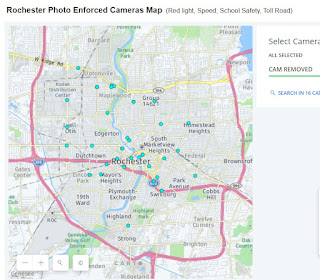
Map of red light cameras removed in Rochester, NY
Rochester, New York, has removed a red-light camera program. The program aims to improve traffic safety by deterring red-light violations and reducing the number of accidents at intersections. Up to 50 intersections in Rochester, New York have been turned off.Under the program, cameras were installed at selected intersections throughout the city. These cameras were capable of capturing images and videos of vehicles that run red lights. When a violation occurs, the recorded evidence is reviewed by law enforcement officials to determine if a citation should be issued.
LAPD Has Only Used Facial Recognition 30,000 Times Since 2009

Fresh face recognition programs, including a "smart vehicle" fitted with face recognition and real-time face recognition cameras, have been repeatedly revealed by the Los Angeles Police Department, yet the agency claimed to have "no documents sensitive" to our document request.
Since 2009, the Los Angeles Police Department has used facial recognition software almost 30,000 times, with hundreds of officers running photographs of criminals against a vast database of mug shots captured by law enforcement from surveillance cameras and other outlets. Are the police using this technology on traffic cameras in Los Angeles?
"It is no secret" that the LAPD uses facial recognition, that he personally testified to that fact before the Police Commission a few years back, and that the more recent denials, including two after last year, one to The Times, were just errors, LAPD assistant chief Horace Frank said.
LAPD spokesman Josh Rubenstein told the paper that the app was used to help classify suspects in crimes without witnesses, gang crimes where witnesses are reluctant to come forward, and by a multi-law enforcement agency task force investigating arsons, burglaries, and other crimes that took place during summer demonstrations over police shootings.
The software was used to equate the geographic database with photographs from crime scenes, witnesses, and surveillance cameras. Rubenstein said the LAPD also doesn't use the program to search crowds or in any live-streaming capacity. He said the program had access to 330 LAPD staff.
A three-year ban on the use of facial recognition systems in police body cameras has been implemented by California. Similar moves in New Hampshire and Oregon were followed by the prohibition. San Francisco and Oakland banned police and other city agencies last year from using any facial recognition. In the Boston suburb of Somerville, Massachusetts, it has also been banned.
Has facial recognition video technology been using on the hundreds of automatic license plate reader traffic cameras throughout the city?

What Is A Red Light Camera?

Red light cameras are a fixture at many intersections across America, and almost every motorist hates to see the infamous camera flash as they drive down the street. Not all red-light cameras require action on your part and will be punished with a fine for not paying the fine. However, since red light cameras are installed at hardly any intersections, the risk of getting a red light camera is low. Many drivers confuse red light cameras for traffic cameras.
Being informed and aware of red light cameras locations is the first line of defense. However, if you get a ticket and have concrete evidence, you may decide not to pay for the ticket. If you are charged with a red light violation or even a traffic violation, hire a local attorney and find out your rights under the law as soon as possible.
As a driver, it can be helpful to understand the difference between a red light camera and conventional traffic cameras near you. In this article, we will discuss how red-light cameras work and how you can find out if you are being photographed by one of these cameras while driving.
How do red light cameras work? A red light camera is programmed to detect vehicles entering an intersection when they turn red. When someone passes a red light at an intersection, a photo or video of the injury is taken. If the red light camera system documents a violation with two photos, the first photo should be taken to show the vehicle operating the red light, as well as the driver of that vehicle and its passenger.
When a vehicle is running a red light, the camera takes a photo or video of the vehicle and records the date, time, vehicle information. Red light violations can occur when a motorist turns right at a junction without stopping. If you receive a red light violation, a Traffic Safety Division police officer will review the ticket before sending it to your address.
Signs must be erected where automated red-light cameras are used in the city. Putting signs at intersections with red-light cameras does not undermine the purpose of installing the cameras.
Research has shown that red light cameras act as an effective deterrent and reduce the number of dangerous light violations that occur when the traffic light turns red. This automated law enforcement system, also known as a "photo enforcement," exists in the United States, Canada, Australia, New Zealand and many other countries around the world.
Most red light camera programs are designed to improve safety at junctions by reducing the number of red light offenses. When the city of Fayetteville last had a red light camera, the number of serious accidents at the intersection where the camera was installed was reduced, and the effect has spread to red light drivers at other camera-equipped locations - as well as to nearby signaled intersections that are not equipped with red-light cameras.
Traffic Camera or Red Light Camera?

A Traffic Monitoring Camera Is Not The Same As A Red Light Camera

Red-light cameras require a big tall box near the intersection, this is where there will be a flash and where pictures are actually recorded. Traffic surveillance is just small cameras, usually on top of the intersection, and it's just a regular, small surveillance camera.
If you do a Google Images search it is wrong. Here are photos of what red light cameras look like.
Connecticut Getting Red Light Cameras?

A Connecticut bill, which was repeatedly described as a work in progress, creates a pilot program allowing towns with populations exceeding 48,000 to install the cameras. The cameras will photograph the license plates of vehicles running red lights or otherwise breaking the law. Owners of vehicles photographed would be issued infractions of up to $50 by mail. According to the bill’s fiscal analysis, the cameras will cost towns between $50,000 and $75,000 for installation and maintenance. However, towns can expect an increase in revenue depending upon how many people are ticketed and how many of them pay the fines.

Ticket for Running a Red Light on a Bike
 |
Bicyclists and Red Light Cameras |
Bicyclists however can be cited for a red light ticket under the California Vehicle Code due to the fact that by statute every person riding a bicycle upon a highway has all the rights and is subject to all the provisions applicable to the driver of a vehicle by this division.
Although a bicyclist could technically be ticketed by Red Light Camera, there is the sheer fact that bicycles do not have a plate on them so the driver of the bicycle cannot be tracked.
State Assemblyman Michael Den Dekker in New York has introduced legislation that, poses the idea of requiring all bicycles to have a license plate, and placing cameras in the bike lanes, so that when a bicycle goes through a red light, they could be tracked down and issued a ticket essentially like registered owners of cars are tracked down and issued a ticket.
There doesn’t appear to be any similar pending legislation in California like that in New York, however, bicyclists in California do face hefty fines if ticketed by an officer (though no demerit points to their motor vehicle driving record).
Contributed by ticketbust.com, helping drivers contest and dismiss their traffic tickets.
Government Employees Avoid Red Light Camera Tickets
 |
California Government Employees Get a Free Ride
|
Approximately 30 years ago, the Confidential Records Program in California makes private license plates available to police officers and other state or government employees so certain workers can choose to keep their DMV info private, like their home address. The law is supposed to keep certain information private like the home address, to prevent say criminals from harassing, threatening, or stalking police officers, judges, etc. This law has been expanded over the years to include numerous other Government or State worker positions (like park rangers) not just police officers or judges and has even been extended to include spouses and children. Furthermore, employees can retain confidentiality for 3 years if they switch to a civilian job, and retired peace officers can remain in the confidential plate program indefinitely.
When someone in the privacy program is detected, the DMV will only release the person’s employing agency to non–police agencies and or to private companies that process citations for cities and counties. The DMV cannot release a home address and therefore a violator with a confidential plate who is caught on camera cannot get a ticket.
There is no question that camera enforcement of traffic violations generates revenue for the State. If the DMV has more than one million vehicles registered to motorists who are connected to a few thousand state and local government agencies that are allowed to opt for confidential plates, this could prevent the State from collecting on millions of dollars in fines from those State workers. These State works can also get out of traffic fines, tolls, or parking tickets. California assemblyman Jeff Miller has taken efforts in hopes to close the gap of this so-called loophole.
Contributed by ticketbust.com, helping drivers contest and dismiss their traffic tickets.
Top 10 Reasons Why Red Light Camera Tickets Are Not Enforced


Depending on the state, county, or province, the laws regarding red light camera ticket citations are different. Some red-light camera ticket photos can't be used or enforced for different reasons. These are the top 10 reasons for the tickets not being enforced:
1) Both images do not show vehicle through the intersection during the red light
2) Unreadable license plate due to glare, lighting or obstruction of license plate
3) No license plate or the dealer plate logo is showing from the transfer of ownership
4) Out of State plates - Not sure about this one in every State?
5) Weather-related image distortion due to rain, snow, dust or wind
6) Invalid or temporary license plates
7) No DMV match to the registered vehicle driver, some states only require a photo of the vehicle
8) Traffic signal, camera, flash malfunction
9) Poor image quality or focus
10) The driver was not you and you may submit a Declaration of Non-liability. Snitch tickets.
As always we would appreciate here feedback about your experiences related to the enforcement of tickets due to these circumstances and any others we are missing. We are especially curious about #4) out of State plates and the enforcement of tickets.
Please do not consider any of the information on this page as legal representative advice to be used in any court of law. PhotoEnforced.com will not be held liable for any information in this article.
Popular Articles (All Time)
-
 Red light camera tickets typically take from 3-7 business days to process and are mailed to the registered owner of the vehicle. We r...
 -
 A Traffic Monitoring Camera Is Not The Same As A Red Light Camera Many of our readers often get confused about the difference betwe...
 -
 If you ever plan on traveling to Downtown Los Angeles on the 110 Freeway I would suggest buying one of these Fast Trak transponders to avoid...
 -
 Red Light Camera Ticket in The Mail It typically takes 5-7 business for a ticket to arrive in the mail in Florida, California, New Yo...
 -
 Red light cameras are increasingly common at busy intersections, and their purpose is to deter dangerous driving and reduce collisions. ...
 -
 The flash of a red light camera is one of the most dreaded things you can see when you pass an intersection. You may have noticed that if...
 -
 Red-light cameras remain one of the most debated traffic enforcement tools in the United States. Supporters argue they save lives by discour...
 -
 Search the Map for " Live Traffic " To Only See Traffic Cameras Bookmark Our Live Traffic Cameras App on Your Phone ...
 -
 Freedom of Information Act Request to Any Government Agency This is the most common question PhotoEnforced.com receives on a daily b...
 -
 Drives Should Be Wary of Short Yellow Lights at Camera Enforced Intersections