Search For Maps & Articles

Showing posts with label Government. Show all posts

Ontario’s Ford Govt Bans School Speed Cameras—Mayors Push Back

Ford Government Bans School-Zone Speed Cameras — But Ontario Mayors Want to Keep Them

Ontario speed cameras banned

The Ford government has banned automated speed-enforcement (ASE) cameras in Ontario school zones, a move that has sparked outrage among mayors across the province. What began as a local safety initiative to protect children walking to school has turned into a major political clash between Queen’s Park and Ontario municipalities.

Premier Doug Ford’s government says the devices are nothing more than “cash grabs,” but mayors argue they’re proven life-savers. From Toronto to Ottawa and Hamilton, local leaders are calling on the province to reverse course—or at least make exceptions for school zones.


What the New Law Does

In 2025, the Ford government passed Bill 56 – Building a More Competitive Economy Act, which includes an amendment to the Highway Traffic Act that bans all municipal speed cameras. This prohibition applies to cameras located in community safety zones and school zones, where most municipalities had placed their ASE devices.

Municipalities have been ordered to shut down their camera programs by mid-November 2025. Cities such as Mississauga and Guelph have already announced deactivation dates around November 14, 2025.

Under the new law:

  • Cities must remove all ASE cameras and related warning signage.

  • Any tickets issued before the cutoff remain valid and must still be paid or contested.

  • The province will replace automated enforcement with larger, standardized school-zone signs and expanded police enforcement.

The government claims these changes will reduce “unfair” ticketing while ensuring students remain safe through alternative methods like flashing beacons, speed bumps, and crossing guards.


Why the Ford Government Banned the Cameras

Premier Ford insists the ban is about fairness for drivers and taxpayers. He argues that many cities were issuing tens of thousands of tickets per month, sometimes at locations where posted speed limits suddenly dropped—leading to perceptions of “speed traps.”

“The cameras have turned into revenue machines,” Ford said during a press conference in September 2025. “Municipalities should not be using drivers as ATMs.”

The government’s argument hinges on three main points:

  1. Consistency – ASE programs were managed differently across municipalities, creating confusion and unequal enforcement.

  2. Fair notice – Tickets arrived weeks later in the mail, offering no immediate feedback to drivers.

  3. Better alternatives – The province says physical road-safety infrastructure, such as speed humps, curb extensions, and flashing signs, can slow drivers more effectively and transparently.

Ford’s critics, however, say the Premier is misrepresenting the data and ignoring years of evidence that ASE saves lives.


Mayors Push Back: “This Will Make Our Roads Less Safe”

Ontario mayors and regional chairs have banded together to oppose the province’s sweeping ban. A joint letter signed by leaders from Toronto, Ottawa, Mississauga, London, Kingston, Hamilton, and Waterloo urged Ford to reconsider.

They argue ASE has delivered measurable safety benefits since its introduction. For example:

  • In Toronto, average speeds in school zones dropped by up to 45% after cameras were installed.

  • Ottawa reported thousands fewer repeat offenders, as drivers learned where cameras were located and slowed down.

  • Hamilton saw reductions in collisions and pedestrian injuries at several previously high-risk intersections.

  • Mississauga noted a steep decline in extreme speeding incidents—vehicles traveling more than 20 km/h over the limit.

Mayors proposed compromises instead of an outright ban:

  • Warning letters for first-time offenders.

  • Operating hours limited to school times only.

  • Uniform thresholds (for example, tickets only issued at 15–20 km/h over the posted limit).

Despite these proposals, the Ford government rejected any exceptions.


The Cities Most Affected

Ontario’s largest cities have invested heavily in ASE over the past five years. Their programs now face dismantling:

  • Toronto operates hundreds of rotating cameras near schools and parks. The city says losing them will undo years of progress made under Vision Zero, its road-safety initiative.

  • Ottawa, the province’s capital, had planned to expand its 36 cameras to 70 before the ban.

  • Hamilton launched its first ASE pilot in 2022, targeting 12 school zones that saw chronic speeding.

  • Waterloo and London both reported positive results in community-zone compliance but must now remove their cameras.

  • Kingston had planned installations for 2026 that are now cancelled.

  • Windsor recently launched its ASE pilot in 2024; the equipment will be removed after less than a year in service.

These cities now face sunk costs for cameras, software contracts, and processing systems—millions of dollars in infrastructure that will soon sit idle.


What Replaces Cameras Now

With ASE banned, municipalities are scrambling to maintain safe speeds around schools. The Ford government has directed cities to emphasize education and engineering:

  • New high-visibility yellow school-zone signs province-wide.

  • Flashing light beacons and digital “Your Speed” boards.

  • Raised crosswalks and speed humps to physically slow traffic.

  • Increased police patrols in known hot spots.

While most cities support these tools, they argue they can’t fully replace automated enforcement. Cameras provide continuous monitoring, freeing police for other duties.


The Evidence Debate: Safety vs. “Cash Grab”

The Case for ASE

Supporters point to peer-reviewed research and municipal data showing ASE reduces both mean speeds and severe crashes. Toronto’s analysis found that serious speeding (over 20 km/h above the limit) dropped by 88% in camera zones. Ottawa documented similar results.

The Ontario Association of Chiefs of Police (OACP) has also publicly opposed the ban, calling ASE “a proven life-saving technology.”

The Case Against ASE

The Ford government and critics claim ASE is more about revenue than safety. Some cameras generated millions in fines annually, prompting concerns about disproportionate impacts on working-class drivers.

The province also argues that ticket processing is inefficient and that mailed fines weeks later don’t create real-time deterrence. They want police presence and road design—not bureaucracy—to shape driver behaviour.

Shared Ground

Both sides agree on one thing: school zones must be safe. The question is whether that safety comes best from a camera lens or a speed bump.


The Political Battle Ahead

Municipalities aren’t giving up. Some are exploring legal options to challenge the ban, arguing the province overstepped by revoking local authority to manage traffic safety.

Others plan to gather post-ban data. If collision or injury rates rise in school zones once cameras are gone, the pressure on the Ford government could intensify.

Local leaders in Toronto, London, and Windsor have already hinted they’ll track changes closely through 2026. The results could determine whether a future government reinstates ASE—possibly limited to school zones only.


What’s Next for Ontario Drivers

As of November 2025, all ASE cameras across Ontario will be powered down. Drivers won’t receive new photo-based speeding tickets, but they should expect:

  • More visible police patrols near schools and parks.

  • Expanded signage reminding them of speed limits.

  • Community campaigns urging voluntary compliance.

Still, safety advocates warn that without constant enforcement, habitual speeders may return to risky behaviour—especially during off-peak hours when patrols are thin.


Bottom Line

Ontario’s ban on school-zone speed cameras represents a major policy reversal. The Ford government views the cameras as unfair and ineffective, preferring road design and education. Ontario mayors—from Toronto and Ottawa to Hamilton, Mississauga, London, Kingston, Waterloo and Windsor—see it as a setback for child safety and local autonomy.

Over the next year, the outcome will hinge on data: if speeding and collisions rise where cameras once stood, political and public pressure could force the province to revisit its decision. Until then, Ontario drivers will see fewer cameras—but the debate over what keeps roads safe is far from over.

The Ghost Plate Problem Spreads from the U.K. to the U.S.

How Do Drivers Do This? The Rise of “Ghost Plates” from the U.K. to the U.S.

Legal & Regulatory Issues of Speed Cameras

Legal & Regulatory Issues of Speed Cameras

The deployment and operation of speed cameras is not only a technological and logistical matter but also a complex legal and regulatory issue. Governments around the world have established laws, frameworks, and approval processes that dictate how automated enforcement systems may be used on public roads. These rules balance public safety goals with fairness, transparency, and compliance with established legal standards. Understanding the legal and regulatory issues behind speed cameras provides drivers, policymakers, and enforcement agencies with clarity on how these devices fit into the broader framework of traffic law and road safety.

Current Legislation Governing Speed Cameras 

Criminal Speeding Laws by State: Complete 50-State Guide

criminal speeding laws by state

Criminal speeding is a serious traffic violation that goes beyond the scope of a simple speeding ticket. While most speeding tickets are considered civil infractions that result in fines and points, certain speeding behaviors cross the line into criminal territory. In these cases, drivers may face misdemeanor or even felony charges, with penalties including jail time, probation, steep fines, license suspension, and a permanent criminal record. Understanding what constitutes criminal speeding in your state is essential to avoid life-altering consequences and to stay safe on the road.

What Is Criminal Speeding?

What Cameras in Orem, Utah Could Help the FBI After the Charlie Kirk

The assassination of conservative activist Charlie Kirk at Utah Valley University has drawn national attention — not only because of the political violence involved, but also because of the technological tools available to investigators. While Orem is not a heavily surveilled city like New York or Chicago, it does have a network of cameras that could assist the FBI as it works to identify the shooter.

Campus Security Cameras 

Why Are Car Makers Allowed to Make Cars That Travel Over 100 MPH?

If you’ve ever looked at your car’s speedometer, you may have noticed that it often goes well beyond the legal speed limits in the United States. Most highways cap out at 65–85 mph, yet even modest family sedans can reach speeds above 120 mph. Sports cars and high-performance vehicles can exceed 200 mph. This raises a common question: why are car manufacturers allowed to make vehicles capable of traveling over 100 mph when drivers are never legally permitted to do so?

Safety Standards vs. Legal Speed Limits

The first distinction is that speed capability and legal speed limits are not the same thing. Manufacturers are required to meet federal safety standards set by the National Highway Traffic Safety Administration (NHTSA), but these standards do not impose a maximum top speed requirement. Instead, they focus on crash safety, emissions, braking systems, and other regulatory factors.

Laws about how fast you can drive are determined at the state and local level. That means your car may be capable of traveling at speeds far beyond what is legally allowed, but you can still be ticketed—or arrested—for attempting it on public roads.

Engineering & Performance Expectations

Modern cars are built with powerful engines for reasons beyond speeding:

  • Highway Merging & Passing Power: Cars need to accelerate quickly and safely to merge onto freeways or pass slower traffic.

  • Durability & Efficiency: Engines designed with extra performance headroom often last longer and handle stress better at normal driving speeds.

  • Global Market Standards: In countries like Germany, parts of the Autobahn have no speed limit. Automakers build vehicles for a worldwide market, not just U.S. laws.

Consumer Demand & Marketing

Automotive culture has long celebrated performance, horsepower, and speed. Even if drivers never push their vehicles past 80 mph, knowing a car could go 140 mph is part of the appeal. Automakers compete by advertising acceleration times (like 0–60 mph) and top-end power. This is especially true for sports cars, luxury vehicles, and performance trims.

Track & Private Use

Cars capable of more than 100 mph aren’t necessarily intended for the street. Many enthusiasts take their vehicles to:

  • Race tracks

  • Private courses

  • Performance driving schools

In those environments, higher speeds are both legal and expected.

Legislative Attempts to Limit Car Speed

Although most vehicles today are capable of traveling far faster than any legal road limit, lawmakers have occasionally tried to rein in manufacturers. The debate resurfaces every decade, usually after spikes in road fatalities or technological changes.

U.S. Proposals

  • 1970s Oil Crisis & Safety Push: During the 1973–74 oil embargo, Congress considered requiring cars to include speed governors to conserve fuel and reduce crashes. Instead, the National Maximum Speed Law (1974) capped highway limits at 55 mph. Manufacturers weren’t forced to restrict cars, but they were pressured to design dashboards that made 55 mph visually prominent.

  • 1990s Electronic Governors: As more cars adopted electronic control units (ECUs), safety advocates proposed mandating top-speed limiters. These proposals never became law, but some manufacturers voluntarily capped vehicles at 112 mph (180 km/h) in the U.S. market.

  • Recent Bills: In 2019 and 2021, federal lawmakers floated ideas tying federal highway funding to states that adopt stricter speed controls or mandate speed-limiting technology for repeat offenders. These bills stalled amid pushback from the auto industry and drivers’ rights groups.

Europe’s Stricter Approach

The European Union has moved faster than the U.S. on electronic enforcement:

  • Since July 2024, all new cars sold in the EU must include Intelligent Speed Assistance (ISA) systems that detect local speed limits and warn drivers—or actively reduce throttle power—if they exceed them.

  • Germany, home of the Autobahn, resisted strict speed caps but accepted ISA technology as a compromise between safety and consumer freedom.

Industry Self-Regulation

Some automakers, particularly in Europe, have taken matters into their own hands:

  • Volvo announced in 2020 that it would limit all new cars to 112 mph (180 km/h), citing road safety goals.

  • Other luxury brands, like BMW and Mercedes-Benz, have “gentlemen’s agreements” to electronically cap most models around 155 mph (250 km/h), even though the cars could go faster.

Why These Attempts Often Fail in the U.S.

Efforts to legislate vehicle speed caps in the United States face resistance because:

  1. Driver Freedom – Americans often view driving as a personal liberty.

  2. Geography – Long, wide highways in rural areas make higher speeds feel safer than in dense European cities.

  3. Enforcement Priority – Lawmakers prefer focusing on enforcement tools like cameras, fines, and license suspensions, rather than restricting manufacturers.

The Role of Technology in Speed Enforcement

Instead of limiting car capabilities, governments increasingly rely on:

  • Speed cameras and red-light cameras to enforce laws.

  • Intelligent Speed Assistance (ISA) technology, already mandated in Europe starting 2024, which warns or limits drivers when they exceed posted speed limits.

  • Telematics and insurance monitoring that track driving behavior.

This shows the trend is moving toward monitoring drivers, not restricting manufacturers.

Conclusion

Car manufacturers are allowed to make vehicles that travel well over 100 mph because engineering, consumer demand, and global standards require it. While drivers are legally restricted by speed limits, automakers design cars with performance headroom for safety, durability, and worldwide use.

Although legislative attempts to restrict speeds have been made in both the U.S. and abroad, most have failed in America due to cultural resistance and practical challenges. Instead, enforcement technology and penalties for drivers remain the preferred tools.

So the next time you glance at your speedometer, remember: just because your car can go 120 mph doesn’t mean you should—or legally can—on public roads.

How States Adopt and Interpret MUTCD Traffic Standards

While the Manual on Uniform Traffic Control Devices (MUTCD) sets national guidelines for road signs, signals, and markings, individual U.S. states adopt and interpret the MUTCD in different ways. This flexibility allows states to tailor traffic control devices to local needs while maintaining general consistency across the country. 

What Do Speed and Red Light Cameras Reveal About a Community?

Speed and red light cameras are more than just automated enforcement tools — they often reflect a community’s values, governance style, public safety priorities, and even its trust dynamics between citizens and local officials. With over 4,000 active red light and speed camera systems across the U.S. and thousands more worldwide, their placement and usage patterns can reveal surprising insights about a region.

Toll Road Scams & Smishing Warnings: What to Know

Toll Road Scams Are on the Rise: What to Know and How Google Messages Is Fighting Back

As cashless toll systems become more prevalent, a new wave of fraud has emerged: toll road scams. These scams typically involve fraudulent text messages claiming the recipient owes unpaid toll fees. This form of smishing (SMS phishing) is spreading rapidly, exploiting the convenience of digital transactions and the trust users place in text messages.

What Is a Toll Road Scam?

A toll road scam is a type of smishing attack where cybercriminals send fake messages impersonating toll agencies. These texts often include a link prompting the user to "pay now" to avoid fines or late fees. Once clicked, victims may be directed to a phishing site or prompted to share personal and financial information.

These scams aren't limited to toll payments. The FBI has issued warnings about smishing attacks impersonating agencies and companies that collect parking tickets, credit card payments, bank alerts, and phone bills. Some scams even masquerade as anti-scam alerts, adding another layer of deception.

A Global Scam That Follows the Sun

Toll road scams are part of a global fraud operation. Scammers "follow the sun," launching waves of attacks throughout the day across different time zones:

  • Morning: Europe

  • Midday: U.S. East Coast

  • Evening: U.S. West Coast

In some cases, scam messages are laughably inaccurate. For instance, users have reported receiving toll fee warnings in states that don't even have toll roads, indicating a mass, untargeted fraud approach.

The Scope of the Problem: Smishing Statistics

The rise of smishing attacks is alarming:

  • Over 10,000 domains have been registered for smishing scams targeting toll services and package deliveries, according to the New York Post.

  • The FBI's Internet Crime Complaint Center (IC3) received over 2,000 reports of toll-related smishing scams in the past year (People.com).

  • Cities like Dallas, Atlanta, and Los Angeles have seen a fourfold increase in smishing scams since January (New York Post).

  • Only 36% of Americans are aware of what smishing is (Bank of America), making many susceptible to these attacks.

  • In April 2022, hackers sent an average of 2.6 billion smishing messages per week (Bank of America).

How Google Messages Is Protecting Users

Recognizing the growing threat of toll road and billing fee scams, Google Messages has implemented new security features to detect and warn users about suspicious messages in real time. Using advanced machine learning and threat intelligence, the app now flags:

Scam likely warning
  • Fraudulent toll payment links

  • Fake billing notifications

  • Unusual message patterns from unknown senders

These enhancements are part of Google's broader initiative to protect Android users from evolving text-based scams and phishing attacks.

What Are Cell Phone Carriers Doing About Smishing?

Cell phone carriers have taken steps to combat smishing:

  • Reporting Mechanisms: Major carriers like Verizon, AT&T, and T-Mobile allow users to report spam texts by forwarding them to 7726 (SPAM).

  • Spam Filtering Tools: Tools like Verizon's Call Filter help users identify and block potential spam messages.

  • User Education: Carriers provide guides to help users recognize and avoid smishing attacks.

Despite these measures, challenges remain:

  • Detection Limitations: Smishing messages evolve quickly, making them difficult to block in real time.

  • User Awareness: Many users are unaware of reporting options or the importance of avoiding suspicious texts.

  • Technological Constraints: SMS infrastructure lacks advanced spam-detection capabilities, limiting carriers’ effectiveness.

How to Spot a Fake Text Message

Experts recommend looking for these red flags:

  • Urgent language or threats of fines or suspension

  • Misspellings or strange links

  • Messages from unknown numbers or odd area codes

  • Requests for personal or financial information

Some scam messages may place the dollar sign after the amount (e.g., "10$" instead of "$10"), a common mistake that signals a fake origin (Bank of America).

What to Do If You Receive One

  • Don’t click any links.

  • Do not respond or provide any information.

  • Report the message by forwarding it to 7726 (SPAM).

  • Use apps like Google Messages that automatically flag scams.

  • Contact the official toll agency directly to confirm if you owe anything.

Final Thoughts

As toll roads go cashless, scammers are exploiting the system’s convenience to deceive users. However, with increased awareness, FBI warnings, and tools like Google Messages’ scam detection, it's becoming easier to identify and avoid these fraudulent schemes. Stay vigilant, verify before you pay, and don’t let scammers take advantage of your trust.

City Councils Exit Costly Verra Mobility Contracts

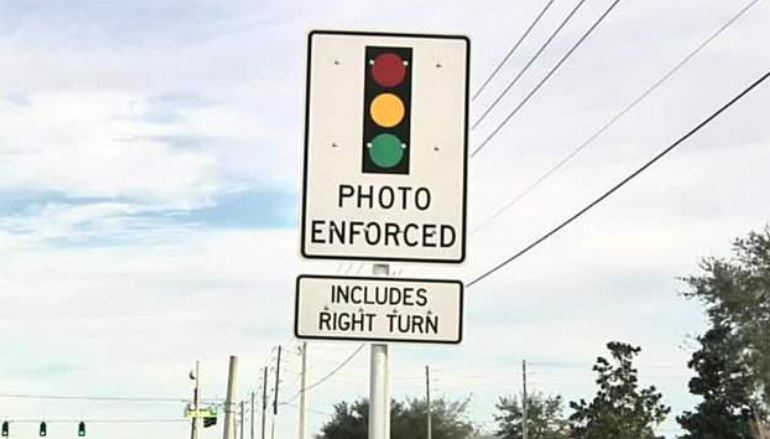
Leon Valley Photo Enforced sign

Across the United States, city councils are beginning to question the value of their traffic enforcement partnerships with Verra Mobility, one of the largest providers of speed and red-light camera systems in the world. Once promoted as turnkey solutions for improving road safety and generating steady municipal revenue, these contracts are now drawing scrutiny over high costs, profit-sharing arrangements, and growing public resistance.

Why Cities Signed on with Verra Mobility

For years, Verra Mobility pitched municipalities on automated enforcement programs with little upfront cost. The company would install cameras at intersections or school zones, manage ticket processing, and handle collections. In return, cities shared a portion of ticket revenue with the vendor.

The appeal was simple:

  • Increased safety by reducing red-light running and speeding.

  • Revenue streams without requiring new taxes.

  • Operational outsourcing so cities didn’t need to hire staff to manage violations.

Many councils signed multi-year agreements, locking themselves into long-term partnerships.

Growing Concerns About Costs

While these contracts once seemed beneficial, costs have become a major sticking point. City leaders increasingly report that the vendor captures too much of the fine revenue, leaving municipalities with less funding than anticipated for public safety programs.

Key issues include:

  • High per-ticket fees charged by Verra Mobility for processing violations.

  • Escalating contract renewals with built-in price increases.

  • Unequal revenue splits, where cities receive less than half of each fine.

  • Legal challenges that have forced cities to refund millions in tickets, without reimbursement from the vendor.

In some cases, local governments discovered that after paying the company’s share, legal costs, and administrative overhead, the net revenue was negligible—or even negative.

Public Backlash and Legal Challenges

Opposition from residents has also pushed councils to reconsider. Critics argue that:

  • Automated enforcement prioritizes revenue over safety.

  • Camera placements often feel like “speed traps” rather than accident-prevention tools.

  • Errors in ticketing can place financial strain on drivers who may have limited ability to contest.

Several lawsuits across the country have challenged the legality of these programs, particularly around issues of due process, faulty calibration, and lack of officer oversight. In states like Texas and California, public pressure has led to bans or severe restrictions on automated enforcement.

Examples of Cities Reconsidering Contracts

  • Albany, Oregon: Council members have debated whether the city’s program justifies its costs after complaints from drivers and rising contract expenses.

  • Chicago, Illinois: While still under contract, leaders continue to face criticism over revenue-driven enforcement.

  • Small suburban towns in Florida and Colorado have chosen not to renew their contracts, citing high costs and resident dissatisfaction.

These examples highlight a growing trend of municipalities seeking to exit or renegotiate their deals with Verra Mobility.

The Political Shift Against Vendor Lock-in

City councils are also increasingly wary of vendor lock-in. Because Verra Mobility owns and operates much of the hardware and software infrastructure, ending a contract often means dismantling an entire enforcement program. This leaves municipalities in a difficult position—either renew at a high cost or risk losing all camera coverage.

Some councils are now exploring alternative models:

  • Running enforcement programs in-house with city-owned cameras.

  • Partnering with competing vendors offering more favorable revenue splits.

  • Transitioning from camera enforcement to increased traffic patrols.

Financial Transparency and Accountability

A recurring theme in council discussions is the lack of transparency in how much money vendors take versus how much is returned to the community. Open records requests have revealed millions flowing to Verra Mobility, while local budgets see only modest returns.

This imbalance has led to calls for:

  • Independent audits of traffic enforcement revenues.

  • Caps on vendor revenue percentages.

  • Shorter-term contracts that allow cities more flexibility to opt out.

What It Means for Drivers

For drivers, the shifting stance of city councils could mean fewer cameras and fewer automated tickets in the future. However, it may also lead to increased police presence on roads if councils replace cameras with traditional enforcement.

It’s also important for motorists to understand that outstanding tickets remain valid even if a city exits its contract. Fines, late fees, and license implications can still apply until legal action or legislation changes enforcement policies.

Conclusion: The Beginning of the End?

City councils across the country are increasingly skeptical of the long-term value of Verra Mobility contracts. While some programs have succeeded in reducing collisions, the high financial costs, legal risks, and community pushback are making them politically untenable.

As more municipalities demand transparency and explore alternatives, the once-booming business model of outsourced traffic enforcement may face significant downsizing. Whether this shift leads to safer roads—or just fewer tickets—remains to be seen.

LEON VALLEY, Texas – After receiving legal council, Leon Valley city leaders voted to write a letter supporting HB 1209.  The bill looks to void any existing contract that goes against a law passed in 2019 that outlaws the use of red light camera programs in Texas.

Which States Allow Speed Cameras?

which states allow speed cameras

Speed cameras—automated devices designed to ticket drivers exceeding posted limits—remain a controversial subject in the United States. Some states view them as essential safety tools, while others ban them entirely, calling them unfair or unconstitutional. As of 2025, the legal landscape continues to shift, with more states adopting targeted enforcement strategies in school zones, work zones, and high-risk corridors.

This article explores which states allow speed cameras, which restrict them, and which ban them outright—plus how legislation has evolved over time.

National Snapshot (2025)

  • 24 states allow some form of speed camera enforcement.

  • 9 states ban or heavily restrict them.

  • 311 communities operate speed camera programs.

  • School zones and work zones remain the most common deployment areas.

States That Ban Speed Cameras

As of 2025, several states maintain laws that prohibit automated speed enforcement, either explicitly or by making implementation impractical. These states include:

  • Maine

  • Mississippi

  • New Hampshire

  • South Carolina

  • Texas

  • West Virginia

States That Allow Speed Cameras (With Conditions)

Many states permit cameras but impose limits on when and where they can be used:

  • School Zones: Georgia, Rhode Island, Florida, Maryland, New York City, and others limit cameras to hours when children are entering or leaving school.

  • Work Zones: Washington, Oregon, Colorado, and Connecticut allow cameras in construction areas, usually only when workers are present.

  • General Use: States such as Illinois, Maryland, and Arizona allow wider deployment, though local ordinances or state caps often apply.

How Laws Differ

Even in states where cameras are legal, restrictions vary:

Rule Type Example Purpose
Time Limits School-zone enforcement only during arrival/dismissal hours Protect children without constant ticketing
Worker Presence Work zones active only when crews are present Prevent unfair tickets in inactive areas
Caps on Use Limits on number of cameras per population Prevent “ticket traps”
Warning Citations First violation may be a warning Build public trust
Civil vs. Moving Violation Tickets often treated as civil fines only Avoid insurance or license penalties

Trends in 2025

  • Expansion of Work Zone Programs: Washington launched trailer-mounted cameras statewide in 2025.

  • School Zone Focus: Many states now restrict camera use to protecting children near schools.

  • Pushback in Legislatures: Georgia and other states are debating new laws to limit or ban cameras.

  • Data-Driven Placement: Cities increasingly use crash data and speed studies to decide where cameras are placed.

Case Studies

  • New York City: Operates one of the largest programs in the U.S., with thousands of cameras in school zones.

  • Maryland: Uses cameras in school zones and work zones statewide.

  • Georgia: Allows only school-zone enforcement, with ongoing debates about fairness.

  • Washington: Rolled out a state-backed work zone program in 2025.

Benefits vs. Criticisms

Supporters argue:

  • Cameras reduce crashes and save lives.

  • Automated enforcement removes bias from policing.

  • Systems operate continuously without requiring manpower.

Critics counter:

  • Programs prioritize revenue over safety.

  • Drivers sometimes brake suddenly, increasing rear-end crashes.

  • Low-income communities may be disproportionately impacted.

  • Legal challenges over fairness and accuracy continue nationwide.

Conclusion

By 2025, the U.S. map of speed camera laws is divided. Some states embrace cameras in targeted areas like schools and work zones, while others reject them as unconstitutional or unfair. The national trend is toward limited, data-driven enforcement with strong local oversight, rather than blanket statewide rollouts.

Timeline Infographic: Evolution of Speed Camera Laws in the U.S.

1990s – First U.S. cities adopt red-light and speed cameras.
2000s – Rapid expansion; dozens of states test pilot programs.
2010s – Backlash grows; several states ban cameras outright.
2020–2021 – Federal infrastructure discussions include automated enforcement funding.
2022 – 18 states allow cameras, 8 states ban them.
2023 – School zone enforcement expands in states like Georgia and Florida.
2024 – Push for work zone cameras in Oregon, Colorado, and Connecticut.
2025 – 24 states permit some form of speed cameras; Washington launches statewide work zone program.

How AI Cameras Are Catching Drivers Doing Things They Shouldn't Be

The use of AI-powered cameras in traffic enforcement is on the rise, and for a good reason. These smart cameras are designed to detect dangerous driving behaviors, helping authorities improve road safety and reduce accidents. From spotting distracted drivers to identifying those not wearing seat belts, AI cameras are becoming an essential tool for law enforcement worldwide.

Will Gavin Newsom Approve Speed Cameras In California?

Speed cameras in California as part of a pilot program

cleared a major hurdle this week. Assemblymember Marc Berman, who co-authored AB 645, said the legislation would help reduce the number of deadly pedestrian accidents.

What's Happening With Joe Biden's New Infrastructure Speed Cameras?

Joe Biden Vision Zero

President Joe Biden on Monday signed into law a sprawling transportation authorization bill that includes, for the first time ever, explicit federal funding support for speed cameras. The one-paragraph provision tucked into a 1039-page bill represents a major win for the photo enforcement industry, which will be the beneficiary of a share of the $2.7 billion in federal taxpayer dollars designated for highway safety programs.

Photo radar operations are generally funded in a "turn-key" arrangement that does not require any investment on the part of cities or states that allow private companies to operate the devices on their behalf. The new law offers direct subsidies for companies that offer this service, nullifying a ban on ticket camera funding that had been in place since 2015.

"A state may expend funds apportioned to the state under this section to carry out a program to purchase, operate, or maintain an automated traffic enforcement system in a work zone or school zone," the Infrastructure and Investment Jobs Act states.

The measure also directs the US Department of Transportation (DOT) to create a study that promotes the use of school bus cameras, requiring it to review "existing state laws that may inhibit the effectiveness of safety countermeasures in school bus loading zones, such as laws that require the face of a driver to be visible in an image captured by a camera if enforcement action is to be taken based on that image; laws that may reduce stop-arm camera effectiveness; [and] the need for a law enforcement officer to witness an event for enforcement action to be taken."

The Transportation Department's own data show fatalities involving school children are most often caused not by motorists illegally passing buses, but by the actions of school bus drivers themselves. From 1983 to 2017, school bus drivers were responsible for 76 percent of fatal accidents involving a school bus. Nonetheless, school bus cameras have spread to 23 states.

The proliferation of bus cameras stalled briefly in 2018 as the stop-arm camera company Force Multiplier Solutions was caught bribing a prominent politician in Dallas, Texas, to make speeches and enact city ordinances on behalf of the bus camera industry. The ensuing scandal sent six school photo enforcement and school board officials to prison. The ill-fated bus camera program also bankrupted Dallas County Schools, but government investigators in Maryland have raised significant concerns about bus camera deals that are still in place.

Researchers in Minnesota have likewise questioned photo enforcement in freeway work zones finding in a study that it did not appreciably change driver behavior compared to alternatives (view study). Washington state installed highway work zone speed cameras "to protect workers" despite not having any worker fatalities caused by motorists in work zones.

"An overwhelming majority -- close to 99 percent -- of people injured or killed in work zone collisions are drivers and passengers," the Washington State Department of Transportation admitted.

National statistics likewise show highway workers are most frequently killed while operating their own equipment.

The photo enforcement firms American Traffic Solutions and Redflex Traffic Systems (both are now Verra Mobility) brought their message to Capitol Hill with a lobbying investment of $2,869,750 over the years. The automobile insurance industry, however, has been the biggest backer of the new law. These companies profit directly from photo tickets issued in states like Arizona and California where automated tickets carry points that raise insurance rates. Liberty Mutual has spent $81,023,120 lobbying Congress, Allstate contributed $78,756,860, State Farm paid out $67,409,239 and USAA invested $810,000 in total.

Source: PDF File HR 3684 as signed (US Congress, 11/15/2021)

Unreliable Speed Cameras Line Government Pockets

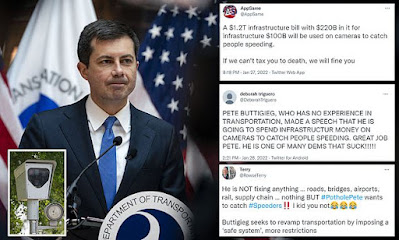
Secretary of Transportation Pete Buttigieg

Secretary of Transportation Pete Buttigieg's new National Roadway Safety Strategy (NRSS) promotes speed cameras nationwide to make our roads safer. But research shows that speed cameras are subject to error and actually end up serving as a means to generate government revenue.

The Department of Transportation (DOT) cited the rise in fatal car crashes, with an 18.4 percent rise in 2021 compared to 2020 according to DOT statistics, as the reason for new safety measures. The DOT wants to take a more active role in centralizing highway safety, with one of the policies in this strategy promoting speed cameras.

NRSS argues that the implementation of speed cameras is a "proven safety countermeasure." The Federal Highway Administration cites research compiled by the Virginia Department of Transportation that shows speed cameras reduce car crashes after they are implemented.

However, the cameras can commit errors when it comes to actually ticketing the right offenders. This can be a problem for drivers—but a windfall for enforcers.

In Chicago, where speed cameras are abundant, the camera program improperly gave out over $2.4 million in fines from 2013 to 2015. Using a random sample analysis, the Chicago Tribune estimated the number of bad tickets to be somewhere around 110,000. The erroneous fines were issued in areas without proper speed limit signs or during times when the cameras should have been turned off. (Cameras near parks and schools operate within a specific timeframe.) The Chicago Tribune found that over half the cameras in use were giving out faulty speeding tickets.

These speed camera accuracy issues are not limited to Chicago. In Washington, D.C., a 2014 report from the D.C. Office of Inspector General found that ticket writers made arbitrary decisions when a camera captured more than one vehicle, and they didn't know which one was speeding. The report stated in "certain instances the process for conclusively identifying the violating vehicle depends too much on an individual reviewer's judgment and, therefore, is not sufficiently precise." One speed camera reviewer told the inspector general's office that they usually ticket "the closer one."

Because of this, the D.C. Office of the Inspector General even suggested that D.C. discontinue the speed camera program, but the cameras are still in use.

Unsurprisingly, the misuse of speed cameras has also become a massive source of revenue for local government. In Chicago, 300 of the city's speed cameras would bring in about $15 million each year. 

In March, Chicago Mayor Lori Lightfoot lowered the speed limit threshold for speed cameras to trigger a citation. Cameras now trigger when a driver goes over the limit by 6 miles per hour, rather than 10 miles per hour, the previous threshold.

According to the Chicago Tribune, in the first two months since Lightfoot's new speed limit rule, the city racked up $11.3 million in fines. The total tickets issued in those two months totaled 327,447. Compared to those same months in 2019, the city only issued 19,480 speeding tickets, making an almost 17-fold increase. 

Although the intention behind Buttigieg's new policy is to create safer roads, speed cameras will likely be better at generating large amounts of cash for local governments. As for the alleged "spike" in fatal car crashes, Reason's Jacob Sullum has explained that we don't yet know whether the upward trend that began in 2020 (not 2021, contrary to media reports) is here to stay, and that regardless, policy proposals should be judged on their merits, not the severity of the problem they're meant to address.  

Reason.com

Biden's New Infrastructure Law Gives States Billions For Speed Cameras

States can now access billions for speed cameras under Biden's infrastructure law

Federal guidance issued Wednesday states that billions of dollars allocated to highway and roadway safety can now go toward installing automated traffic enforcement, such as speed and red-light cameras.

The allocated funds come from President Biden’s infrastructure law.

The decision to open the funding toward automated traffic enforcement aims to curb the recent increases in traffic-related deaths.

Roadways in the U.S. could receive an influx in speed cameras, thanks to new funds from President Biden’s infrastructure law. 

Federal guidance issued Wednesday states that billions of dollars allocated to highway and roadway safety can now go toward installing automated traffic enforcement, such as speed and red-light cameras.  

Previously, transportation funds allocated to states were largely limited to fund projects such as reinforcing bridges and roadways, with federal funds for speed cameras only permitted for school zones. However, Biden’s infrastructure law allows states to utilize up to 10 percent of their $15.6 billion highway safety funds, distributed over five years, on “non-infrastructure programs” such as automated traffic enforcement and public awareness campaigns. 

America is changing faster than ever! Add Changing America to your Facebook or Twitter feed to stay on top of the news.  

The decision to open the funding toward automated traffic enforcement aims to curb the recent increases in traffic-related deaths.   

“Almost 95 percent of our Nation’s transportation deaths occur on America’s streets, roads, and highways, and they are on the rise,” U.S. Transportation Secretary Pete Buttigieg said in the National Roadway Safety Strategy release. “An estimated 38,680 people died in motor vehicle crashes in 2020. In the first half of 2021, an estimated 20,160 people died, up 18.4 percent compared to the first six months of 2020.”  

Critics have countered that the cameras can be inaccurate and act as more of a source of revenue for communities rather than a speeding deterrent. In fiscal year 2020, Washington, D.C., brought in about $148 million in traffic fines, a majority of which came from speed and red-light cameras, even amid the coronavirus pandemic, according to Washington Business Journal. An analysis even found that D.C. issued more fines than any U.S. city. 

“Speeding increases both the frequency and severity of crashes, yet it is both persistent and largely accepted as the norm amongst the traveling public,” according to the Transportation Department’s National Roadway Safety Strategy. “Automated speed enforcement, if deployed equitably and applied appropriately to roads with the greatest risk of harm due to speeding, can provide significant safety benefits and save lives.” 

TheHill.com

AI Cameras Being Used to Detect Phone Usage In Cars

Man looking at phone in car

The use of AI cameras to detect phone usage in cars is an emerging technology that aims to address the issue of distracted driving. These cameras are designed to monitor and analyze driver behavior, specifically focusing on detecting when drivers are using their mobile phones while operating a vehicle.

AI-based camera systems utilize computer vision and machine learning algorithms to analyze real-time video footage and identify signs of distracted driving, such as drivers holding and using their phones while driving. These systems can distinguish between different activities, like making a phone call, texting, or using social media, and can trigger alerts or notifications when a violation is detected.

The deployment and use of AI cameras for detecting phone usage in cars can vary depending on local laws and regulations. Some jurisdictions have implemented or are considering implementing these systems as a means of improving road safety and enforcing distracted driving laws. However, it's important to note that the implementation and acceptance of such technologies can differ between regions, and privacy concerns may also be a factor to consider.

As with any emerging technology, it is advisable to refer to local laws, regulations, and official sources in your jurisdiction to understand the current status and legality of using AI cameras to detect phone usage in cars. Additionally, monitoring developments in this field and staying informed about the latest advancements can provide a more accurate understanding of how this technology is being utilized.

Australia put up the first phone-detecting cameras in New South Wales over the weekend. The move is part of a broader plan to reduce roadway fatalities by 30 percent by 2021 — especially as new technologies continue to exacerbate the issue of distracted driving. “It’s a system to change the culture,” NSW Police Assistant Commissioner Michael Corboy told Australian media las week.

There’s nothing incredibly new about the cameras themselves. But they’re networked to an artificial intelligence that determines whether or not someone behind the wheel is using their phone. Suspect images are then forwarded to authorized personnel to be verified as truly criminal.

New South Wales wants to put up 45 portable cameras over the next three years, moving them occasionally to keep people on their toes. For the first three months, starting now, offending drivers will only receive warning letters in the mail. The penalty then becomes a $344 AUD ($233 USD), which gets a bit higher in school zones, and some points on their license (again, more in a school zone). Minister for Regional Roads Paul Toole said the program will progressively expand to perform an estimated 135 million vehicle checks on NSW roads each year by 2023.

Critics of the plan are worried that the cameras sacrifice privacy for negligible safety gains. There have also been fears that the courts could become overwhelmed by drivers disputing bogus claims if the system isn’t spot on with its detection.

While numerous outlets are calling this a world’s first, the Netherlands recently put a similar system in place to catch distracted drivers. China also has a system like this (a rather expansive one) and intends on connecting it to its social credit score program early next year.

“The NSW Government is serious about reducing our state’s road toll and rolling out mobile phone detection cameras is another way we will do this,” explained Minister for Roads Andrew Constance. “As we enter a notoriously dangerous time of the year on our roads I want all drivers to know that if you use your mobile phone while behind the wheel of a vehicle in NSW you will have a greater
chance of being caught, anywhere at anytime … Some people have not got the message about using their phones legally and safely. If they think they can continue to put the safety of themselves, their passengers and the community at risk without consequence they are in for a rude shock.”

Popular Articles (All Time)